

If you’re starting clear aligners, your dentist may mention small, tooth coloured bumps called clear aligner attachments. They can look like a minor detail, but they play a real part in how your aligner treatment works.
At Pearl Dental Care, we take the time to walk you through each part of your aligner plan, attachments included, so you know what’s involved before anything begins.
Quick Overview
- Clear aligner attachments are small, tooth coloured shapes bonded to certain teeth to help aligners grip and guide them.
- They’re often used in clear aligner treatment, though not every patient, or every tooth, needs them.
- They may help with specific tooth movements that a smooth plastic tray can find harder to manage on its own.
- Their shape, size and placement depend on your treatment planning, and how well you wear your aligners can also influence results.
- Whether attachments are part of your plan is something your dentist can explain once your teeth have been assessed.
Below, we explain how attachments work, how they’re placed and removed, and what to expect day to day.
What Are Clear Aligner Attachments?
 Clear aligner attachments are small bumps made from tooth coloured composite resin, the same type of material used for white fillings. They’re bonded onto the tooth surface of specific teeth to give your aligners something to hold onto, so the trays can apply force in a more controlled direction.
Aligners are thin and slightly flexible, so on a smooth surface, a tray can slip a little as it pushes. Attachments act a bit like handles. Each aligner is shaped to fit snugly over them, so the tray can gently push or turn the tooth towards its desired position.
You may also hear them called aligner attachments. The name often depends on the aligner brand, but the basic idea is similar across systems, and they’re a common part of modern orthodontic treatment.
Why Do Some Teeth Need Attachments?
Tipping a tooth slightly forward or back is fairly simple for an aligner. More complex movements can be harder, such as:
- Turning a rounded tooth, like a canine tooth or premolar
- Moving a tooth up or down in the gum
- Moving the root as well as the crown, rather than just tilting the tooth
- Holding back teeth steady while front teeth move
Research suggests attachments may help with root movement, rotations and moving teeth along the arch, though results across studies aren’t always consistent. A broader review of the evidence also found that attachment design and placement should be tailored to each patient, as no single setup suits everyone.
Attachments can also help keep the aligner properly seated, which may reduce unwanted movements in teeth that are meant to stay still.
How Are Attachments Placed and Removed?
Attachments are usually placed when you receive your first aligners. The process typically looks like this:
- The tooth surface is cleaned and lightly prepared so the material can bond.
- A thin bonding agent is applied.
- A template aligner, filled with composite material in the planned shapes, is fitted over your teeth.
- A curing light sets the composite, then the template is gently removed.
- Any excess material is tidied up.
When treatment finishes, the attachments are gently removed, and the tooth is polished back to a smooth surface. Your dentist will then talk you through retainers, which help hold your teeth in their new position.
What Affects How Clear Aligner Attachments Work?
Several things can influence how well attachments do their job, and treatment outcomes vary depending on your individual situation: 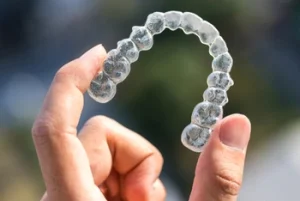
- Shape and size. Attachments come in different shapes. A rectangular shape is common, while others are bevelled or rounded for particular movements.
- Position on the tooth. Where an attachment sits changes how the aligner applies force.
- The planned movements. Complex cases with more turning or root movement may need more attachments than mild crowding.
- Wear time. Attachments can’t do much if your aligners spend long periods out of your mouth.
- Attachment condition. An attachment can occasionally chip or come off. If this happens, let your dentist know so it can be checked and replaced if needed.
How to Care For Your Teeth During Clear Aligner Treatment
Attachments add a few small ridges to your teeth, and plaque can collect around their edges more easily. A little extra care helps:
- Brush twice a day with fluoride toothpaste, paying attention to the edges of each attachment.
- Clean between your teeth every day.
- Clean your aligners when you brush.
- Take your aligners out to eat and for drinks other than water, as sugary or acidic drinks can get trapped against your teeth.
- Keep up with your regular check-up and clean.
Australian dental guidance highlights the importance of brushing and cleaning between your teeth during orthodontic treatment. It also advises against do-it-yourself teeth straightening without an in-person assessment and ongoing supervision.
A Considered Approach to Clear Aligner Attachments
 Attachments are one small part of a bigger plan. Whether you need them, how many you need and where they go all depend on your teeth, your bite and the movements your plan involves.
If you’d like to find out whether clear aligners may suit you, and what attachments would mean for your treatment, our friendly team in St Marys is here to help. We’ll talk you through your options at a pace that suits you, with no pressure to decide on the day.
Call Pearl Dental Care on 02 9158 6312 or get in touch with our team online.
Frequently Asked Questions
Do clear aligner attachments hurt?
Placing attachments doesn’t usually require an injection. It’s common to feel mild discomfort or pressure when a new aligner is fitted over them, which tends to settle within a few days. Let your dentist know if an attachment feels sharp or rubs against your lip or cheek.
How long do aligner attachments stay on?
They usually stay on for the length of your aligner treatment, which can vary depending on your case. Some attachments may be added or removed partway through if your plan is adjusted.
Can attachments damage your teeth?
Attachments are bonded to the outer surface of the tooth and polished off by your dentist at the end of treatment. Keeping them clean matters, as plaque can build up around the edges.
Are aligner attachments noticeable?
They’re tooth coloured, so they tend to blend in, especially under clear aligners. People may notice them up close, particularly on front teeth, and the material can pick up some staining over time.
What happens if an attachment falls off?
Contact your dentist and let them know which set of aligners you’re up to. Keep wearing your aligners unless advised otherwise, and your dentist can tell you whether the attachment needs to be replaced to keep your planned movements on track.
References
- Effects of composite attachments on orthodontic clear aligner therapy: a systematic review (Materials, 2022): https://pmc.ncbi.nlm.nih.gov/articles/PMC8778413/
- Understanding the effectiveness of attachments in clear aligner therapy: design, placement, material selection and biomechanics (Australasian Orthodontic Journal, 2024): https://reference-global.com/article/10.2478/aoj-2024-0021
- Teeth straightening and braces (Teeth.org.au, Australian Dental Association): https://teeth.org.au/teeth-straightening-and-braces